Powered by Blogger.
Showing posts with label Science and Technology. Show all posts

Saturday, July 5, 2014

, ,

Microscopic Image Of Mona Lisa

The Micro Lisa: Incredible 'molecular painting' of masterpiece that is three times narrower than a HUMAN HAIR

  • The tiny picture is 'painted' on a substrate that is just 30 microns in width using tiny chemical reactions
  • American scientists controlled the number of new molecules created - the greater the heat, the darker the shade of grey
  • Researchers at the Georgia Institute of Technology believe 'Mini Lisa' demonstrates a technique that could be used in nanomanufacturing 

American scientists have recreated the world's most famous painting on the world's smallest canvas, which measures just 30 microns in width.
The Mona Lisa, originally painted by Leonardo da Vinci, has now been 'painted' on a substrate measuring one third of the width of a human hair, using tiny chemical reactions.
The scientists believe 'Micro Lisa' demonstrates a technique that could potentially be used to achieve nanomanufacturing of devices as they were able to vary the surface concentration of molecules on such short-length scales.

Researchers from the Georgia Institute of Technology have created the 'Mini Lisa' on a substrate surface approximately 30 microns in width. The image demonstrates a technique that could potentially be used to achieve nano-manufacturing of devices

The Mona Lisa by Leonardo da Vinci, which is the best known and most parodied painting in the world
The famous image was re-created with an atomic force microscope and a process called ThermoChemical NanoLithography (TCNL).
Going pixel by pixel, scientists at the Georgia Institute of Technology positioned a heated cantilever at the substrate surface to create a series of confined nanoscale chemical reactions.

By varying only the heat at each location, PhD Candidate Keith Carroll controlled the number of new molecules that were created - the greater the heat, the greater the local concentration.
More heat produced the lighter shades of grey, as seen on the Mini Lisa's forehead and hands.

Less heat produced the darker shades in her dress and hair, which can be seen when the molecular canvas is visualised using fluorescent dye. Each pixel is spaced by 125 nanometers.

Jennifer Curtis, an associate professor in the School of Physics and lead author of the study that was published in journal Langmuir, said: 'By tuning the temperature, our team manipulated chemical reactions to yield variations in the molecular concentrations on the nanoscale.

'The spatial confinement of these reactions provides the precision required to generate complex chemical images like the Mini Lisa.'

The famous image was re-created with an atomic force microscope (pictured) and a process called ThermoChemical NanoLithography (TCNL). Going pixel by pixel, scientists positioned a heated cantilever at the substrate surface to create a series of confined nanoscale chemical reactions

Production of chemical concentration gradients and variations on the sub-micrometre scale are difficult to achieve with other techniques.

The scientists produced chemical gradients of amine groups, but expect the process could be extended for use with other materials.
Professor Curtis said: "We envision TCNL will be capable of patterning gradients of other physical or chemical properties, such as conductivity of graphene.

Professor Curtis (pictured) said technique should enable a wide range of previously inaccessible experiments and applications in fields as diverse as nanoelectronics, optoelectronics and bioengineering
'This technique should enable a wide range of previously inaccessible experiments and applications in fields as diverse as nanoelectronics, optoelectronics and bioengineering.'
She said another advantage is that atomic force microscopes are fairly common and the thermal control is relatively straightforward, making the approach accessible to both academic and industrial laboratories.

To facilitate their vision of nano-manufacturing devices with TCNL, the Georgia Tech team has recently integrated nanoarrays of five thermal cantilevers to accelerate the pace of production.
Because the technique provides high spatial resolutions at a speed faster than other existing methods, even with a single cantilever, Professor Curtis is hopeful that TCNL will provide the option of nanoscale printing integrated with the fabrication of large quantities of surfaces and everyday materials, whose dimensions are more than one billion times larger than the TCNL features themselves.
Publisher: Unknown - 5:56 PM

Monday, February 4, 2013

Raising The Costa Concordia

In January, the cruise ship Costa Concordia struck a rock off the shore of Isola del Giglio, in the Mediterranean.30 people on board the largest passenger wreck of all time lost their lives; two are still missing. Nearly a year later, the wreck is still sitting off the Italian coast, mostly submerged.
Because the Costa Concordia is in a nationally protected marine park and coral reef, it must be removed from the area before it can be dismantled, posing countless difficulties. In a report on the efforts to remove the wreck, 60 Minutes' Leslie Stahl visited the site and recounted the remarkable salvage operation, which has a $400 million price tag.Not only is it the riskiest, most complicated, and most expensive salvage plan ever undertaken, but no one is sure if it will work.
The ship weighs 60,000 tons and is filled with seawater.
It is sitting on two underwater mountain peaks. 65 percent of it is below the surface.

The wreck is an official crime scene.

The operation, which will cost about $400 million, is being paid for by insurance companies.

The plan is to rotate the ship upright, and onto an underwater platform.

Then it will float up, leaving more of its structure above the surface.

And it can be towed away.

Before getting on the inclined ship, workers must take a 4-day mountain climbing course.

The underwater platform is being built in northern Italy. The steel must be transported through the Adriatic Sea, around the boot of Italy, and up to the wreck.

The steel that makes it up weighs three times as much as the Eiffel Tower. It will be embedded in the seafloor.

The drill bit will be enclosed in a large tube, to keep debris from contaminating the protected area.

For now, the ship is held in place by steel cables, but strong storms could dislodge it. Then it would sink to the seafloor, making the salvage operation near impossible.

111 salvage divers are currently working on the salvage operation around the clock, in 45-minute shifts. They attached the cables holding the ship where it is.

They all live in floating barracks, next to the wreck site.

How exactly will workers rotate Costa Concordia onto the platform?
The plan essentially involves "weld[ing] a new ship onto the shipwreck,"
Stahl reports.

That new "ship" will consist of huge, hollow steel boxes.

Called sponsons, the biggest are 11 stories tall.

9 will be welded onto the exposed side of the ship, with just 2 inches between them.

Then steel cables will connect the sponsons to the steel platform.

Hydraulic pulleys will pull the 'Costa Concordia' upright.

More sponsons will be welded onto the other side of the ship.

Once the ship is upright, the extra buoyancy should make it float.

The ship will be floated next summer.
Once the process begins, there is no way to stop it, even if something goes wrong.

The backup plan is to break it up where it lies, at a huge cost to the local environment.

If all goes well, the 'Costa Concordia' will be cut up for scrap, far from Giglio. It is so large, the process will take 2 years.


Publisher: Unknown - 10:12 PM

Saturday, February 2, 2013

Moon Base

One small hut for man: European Space Agency unveils plans for mankind's first habitable MOON BASE... built almost entirely out of lunar soil by robots

  • 3D printing technology will transform raw lunar soil into livable domes
  • Will house four people and protect them from meteorites and gamma radiation
  • Could be ready for humans to move in within the next 40 years
Blueprints for mankind's first habitable lunar base were unveiled today... and it will be build by robots almost entirely out of 'Moon soil'.
The outpost, designed by the European Space Agency, will be built using state-of-the-art 3D printing technology to transform raw lunar soil into livable domes.
The ESA teamed up with architectural firm Foster + Partners in a bid to set the wheels in motion for a permanent human presence on Earth's only natural satellite.
And experts say it could be ready for humans to move in within the next 40 years.
Built by robots: The structure will house four people,            and can offer protection from meteorites, gamma radiation and            vast temperature fluctuations
Built by robots: The structure will house four people, and can offer protection from meteorites, gamma radiation and vast temperature fluctuations
Autonomous robots will be used to 3D print a cellular structure to house four people, and can offer protection from meteorites, gamma radiation and vast temperature fluctuations.
The ESA's human spaceflight team's Scott Hovland said: '3D printing offers a potential means of facilitating lunar settlement with reduced logistics from Earth.'
The theory is that 90 per cent of the materials needed to build the structure already exists on the Moon, so only
the robots and light-weight parts, such as inflatables and the solid connector and entry segments, will have to be ferried from Earth.
Ambitious: The ESA teamed up with architectural firm            Foster + Partners in a bid to set the wheels in motion for a            permanent human presence on Earth's only natural satellite
Ambitious: The ESA teamed up with architectural firm Foster + Partners in a bid to set the wheels in motion for a permanent human presence on Earth's only natural satellite
Autonomous robots will be used to 3D print a cellular            structure fit for habitation
Autonomous robots will be used to 3D print a cellular structure fit for habitation
The few parts that would need to be made on Earth would be folded from a tubular module that can be transported by space rocket.
To ensure strength while keeping the amount of binding 'ink' to a minimum, the shell is made up of a hollow closed cellular structure similar to foam.
Publisher: Unknown - 9:45 PM

Garden in a Bottle

Thriving since 1960, my garden in a bottle: Seedling sealed in its own ecosystem and watered just once in 53 years

  • David Latimer first planted his bottle garden in 1960 and last watered it in 1972 before tightly sealing it shut 'as an experiment'
  • The hardy spiderworts plant inside has grown to fill the 10-gallon container by surviving entirely on recycled air, nutrients and water
  • Gardeners' Question Time expert says it is 'a great example just how pioneering plants can be'
  • By David Wilkes
To look at this flourishing mass of plant life you’d think David Latimer was a green-fingered genius.
Truth be told, however, his bottle garden – now almost in its 53rd year – hasn’t taken up much of his time.
In fact, on the last occasion he watered it Ted Heath was Prime Minister and Richard Nixon was in the White House.

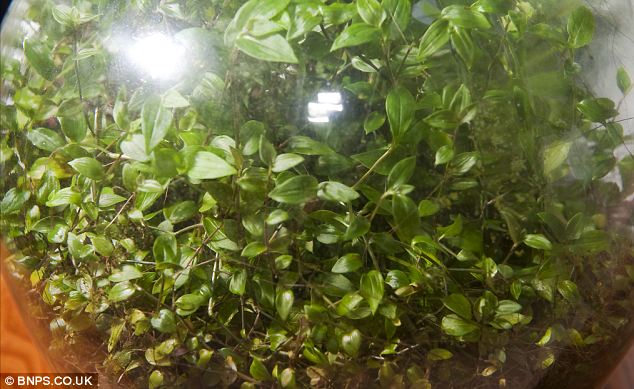
Still going strong: Pensioner David Latimer from Cranleigh, Surrey, with his bottle garden that was first planted 53 years ago and has not been watered since 1972 - yet continues to thrive in its sealed environment
For the last 40 years it has been completely sealed from the outside world. But the indoor variety of spiderworts (or Tradescantia, to give the plant species its scientific Latin name) within has thrived, filling its globular bottle home with healthy foliage.
Yesterday Mr Latimer, 80, said: ‘It’s 6ft from a window so gets a bit of sunlight. It grows towards the light so it gets turned round every so often so it grows evenly.
‘Otherwise, it’s the definition of low-maintenance. I’ve never pruned it, it just seems to have grown to the limits of the bottle.’
The bottle garden has created its own miniature ecosystem. Despite being cut off from the outside world, because it is still absorbing light it can photosynthesise, the process by which plants convert sunlight into the energy they need to grow.

Lush: Just like any other plant, Mr Latimers's bottled specimen has survived and thrived using the cycle of photosynthesis despite being cut off from the outside world

HOW THE BOTTLE GARDEN GROWS

Bottle gardens work because their sealed space creates an entirely self-sufficient ecosystem in which plants can survive by using photosynthesis to recycle nutrients.
The only external input needed to keep the plant going is light, since this provides it with the energy it needs to create its own food and continue to grow.
Light shining on the leaves of the plant is absorbed by proteins containing chlorophylls (a green pigment).
Some of that light energy is stored in the form of adenosine triphosphate (ATP), a molecule that stores energy. The rest is used to remove electrons from the water being absorbed from the soil through the plant's roots.
These electrons then become 'free' - and are used in chemical reactions that convert carbon dioxide into carbohydrates, releasing oxygen.
This photosynthesis process is the opposite of the cellular respiration that occurs in other organisms, including humans, where carbohydrates containing energy react with oxygen to produce carbon dioxide, water, and release chemical energy.
But the eco-system also uses cellular respiration to break down decaying material shed by the plant. In this part of the process, bacteria inside the soil of the bottle garden absorbs the plant's waste oxygen and releasing carbon dioxide which the growing plant can reuse.
And, of course, at night, when there is no sunlight to drive photosynthesis, the plant will also use cellular respiration to keep itself alive by breaking down the stored nutrients.

Because the bottle garden is a closed environment, that means its water cycle is also a self-contained process.
The water in the bottle gets taken up by plants’ roots, is released into the air during transpiration, condenses down into the potting mixture, where the cycle begins again.
Photosynthesis creates oxygen and also puts more moisture in the air. The moisture builds up inside the bottle and ‘rains’ back down on the plant.

The leaves it drops rot at the bottom of the bottle, creating the carbon dioxide also needed for photosynthesis and nutrients which it absorbs through its roots.

It was Easter Sunday 1960 when Mr Latimer thought it would be fun to start a bottle garden ‘out of idle curiosity’.
He said: ‘At the time the chemical industry had changed to transporting things in plastic bottles so there were a lot of glass ones on the market.

‘Bottle gardens were a bit of a craze and I wanted to see what happened if you bunged the thing up.’


Habitable zone: The spot under the stairs where Mr Latimer has kept the bottle garden for the past 27 years

Into a cleaned out ten gallon carboy, or globular bottle, which once contained sulphuric acid, he poured some compost then carefully lowered in a seedling using a piece of wire.
He put in about a quarter of a pint of water. It was not until 1972 that he gave it another ‘drink’.
After that, he greased the bung so it wedged in tightly... and has not watered it since.
The bottle stands on display under the stairs in the hallway of his home in Cranleigh, Surrey, the same spot it has occupied for 27 years after he and his wife Gretchen moved from Lancashire when he retired as an electrical engineer.
It was revealed to the world when he took a photograph of it in to BBC Radio 4’s Gardeners’ Question Time and asked the panel of experts if it is ‘of scientific or horticultural interest’.
Garden designer and television presenter Chris Beardshaw said: ‘It’s a great example of the way in which a plant is able to recycle... It’s the perfect cycle of life.’
He added that this process is one reason why NASA was interested in taking plants into space.
‘Plants operate as very good scrubbers, taking out pollutants in the air, so that a space station can effectively become self-sustaining,’ he said. ‘This is a great example of just how pioneering plants are and how they will persist given the opportunity.
‘The only input to this whole process has been solar energy, that’s the thing it has needed to keep it going. Everything else, every other thing in there has been recycled. That’s fantastic.’
Organic gardener Bob Flowerdew was less enthusiastic.
‘It’s wonderful but not for me, thanks. I can’t see the point. I can’t smell it, I can’t eat it,’ he said. Mr Latimer agrees the bottle garden is ‘incredibly dull in that it doesn’t do anything’, but remains fascinated to see how long it will last.
He hopes to pass on the ‘experiment’ to his grown-up children after he is gone.
If they do not want it, he will leave it to the Royal Horticultural Society.
Publisher: Unknown - 8:55 PM